CASE STUDY
Bluetooth Based Mobile to Raspberry Pi Communicator POC
Proof Of Concept
Integration POC
Integration POC
Overview
A proof of concept (POC) was developed to demonstrate secure and efficient Bluetooth communication between mobile devices and Raspberry Pi Zero for automated lighting control. The system implements a centralized decision-making architecture where the Raspberry Pi validates user proximity and authenticity before triggering LED activation. This POC successfully validates the feasibility of using Bluetooth Low Energy (BLE) for reliable device-to-device communication in IoT applications while maintaining security through centralized authentication.
The Challenge
The POC aimed to validate a Bluetooth-based communication system that could:
- Accurately detect and authenticate authorized users
- Activate lighting only for valid users within a specific proximity
- Maintain security by preventing unauthorized access
- Operate reliably in environments with multiple Bluetooth signals
- Function continuously with minimal maintenance
- Scale efficiently for multiple users and access points
Key technical challenges included:
- Managing Bluetooth signal interference in busy environments
- Ensuring real-time response despite processing limitations
- Maintaining system security while allowing easy access for authorized users
- Optimizing power consumption for continuous operation
- Handling regular data synchronization without disrupting core functionality
Our Solution
The system follows a centralized decision-making architecture where the Raspberry Pi acts as the primary control unit. The process flow is as follows:
- Mobile Broadcasting Mobile device continuously broadcasts its unique ID via Bluetooth Broadcasts occur at regular intervals in the background
- Mobile Broadcasting
- Mobile device continuously broadcasts its unique ID via Bluetooth
- Broadcasts occur at regular intervals in the background
- Signal Reception & Distance Calculation Raspberry Pi constantly scans for Bluetooth broadcasts Upon receiving a signal, calculates distance using RSSI values Implements distance threshold checking
- Signal Reception & Distance Calculation
- Raspberry Pi constantly scans for Bluetooth broadcasts
- Upon receiving a signal, calculates distance using RSSI values
- Implements distance threshold checking
- User Validation For nearby devices, system checks user validity against cached list Valid user list is synchronized with cloud database periodically Maintains local cache for offline operation
- User Validation
- For nearby devices, system checks user validity against cached list
- Valid user list is synchronized with cloud database periodically
- Maintains local cache for offline operation
- Action Execution Valid users within range trigger LED activation System maintains state for continuous operation Implements debouncing to prevent rapid switching
- Action Execution
- Valid users within range trigger LED activation
- System maintains state for continuous operation
- Implements debouncing to prevent rapid switching
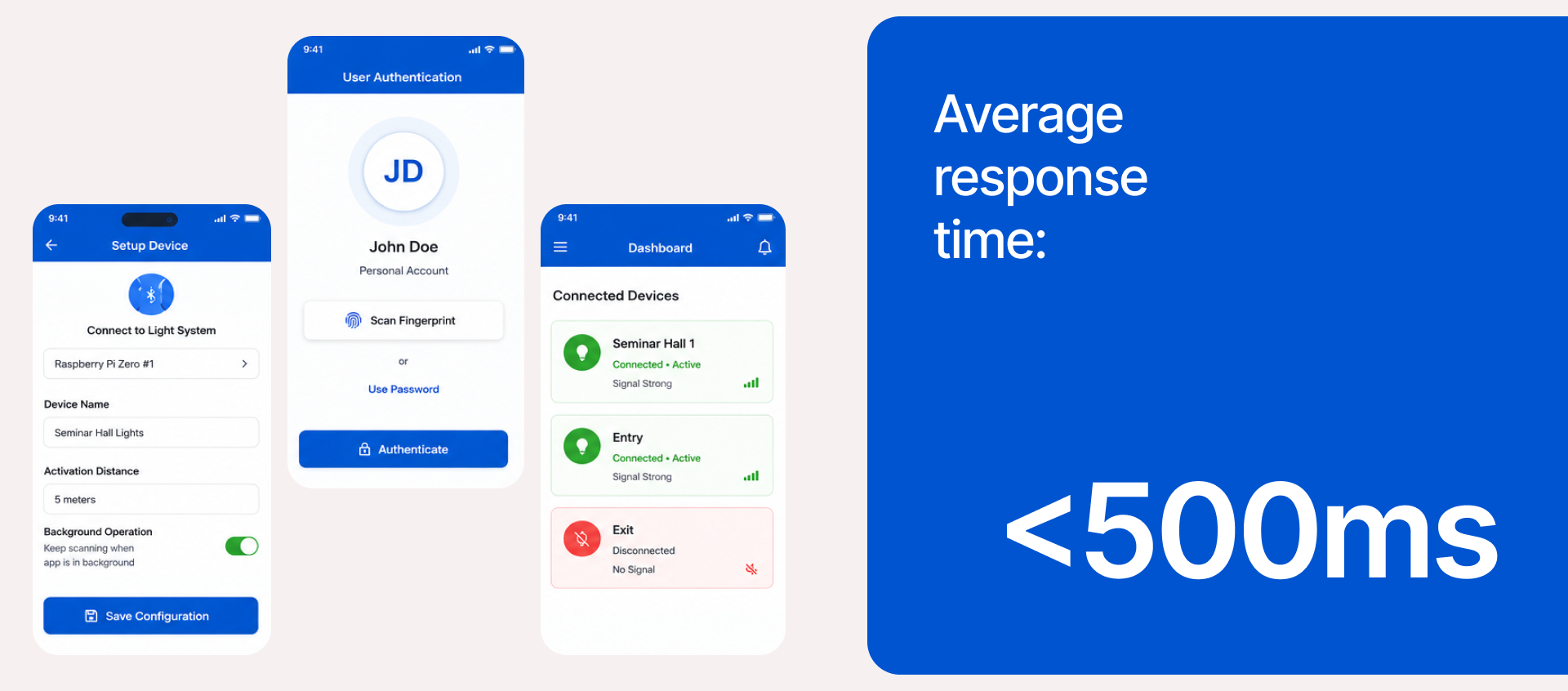
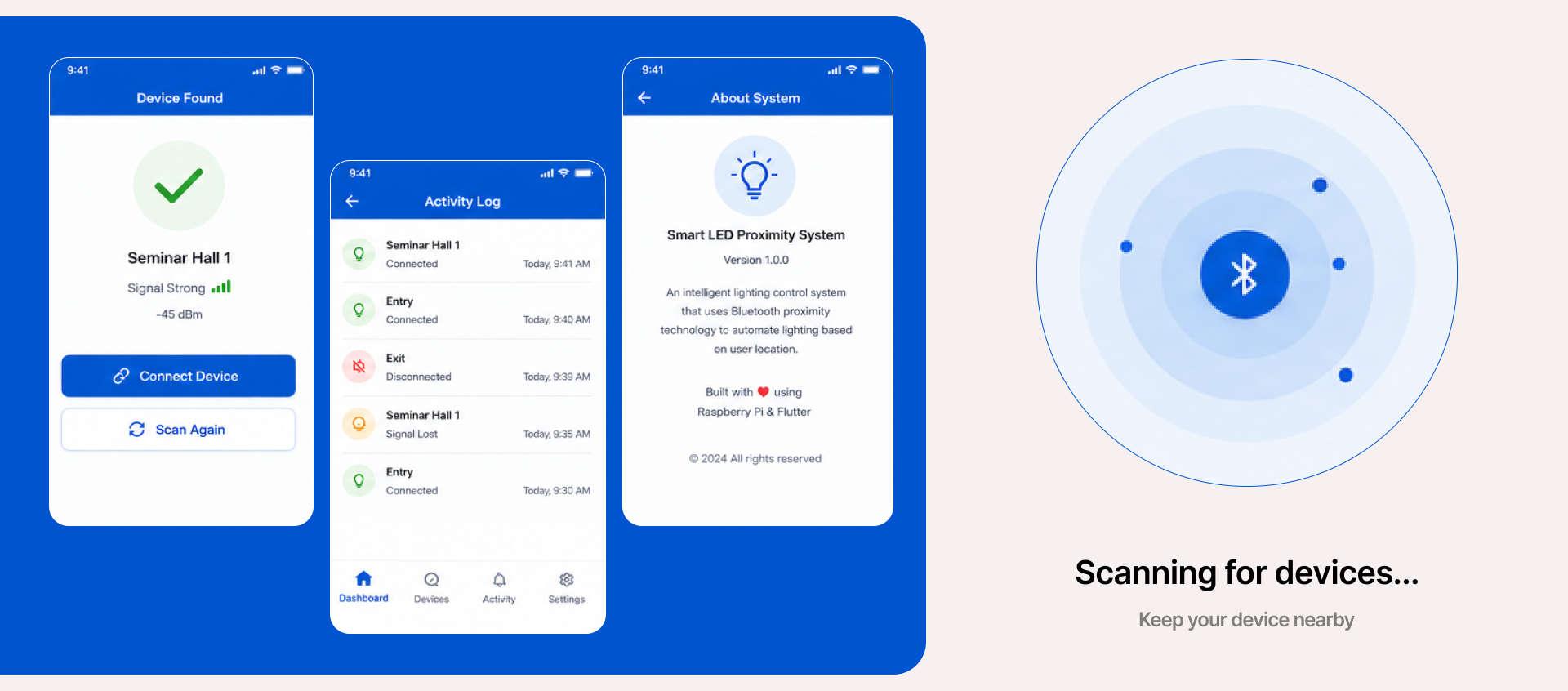
Integrated System Components
Hardware Components
- Raspberry Pi Zero (Central Control Unit)
- LED lighting system
- Mobile devices (User Interface)
- WiFi router (2.4GHz connectivity)
Raspberry Pi Application
- Python-based core application
- Bluetooth signal processing module
- Distance calculation algorithm
- Local cache management system
- Authentication validation module
- LED control interface
Mobile Application (Flutter)
- Cross-platform mobile app (iOS/Android)
- Bluetooth broadcasting module
- Background service management
- User authentication interface
- Configuration settings
Performance Optimizations
Signal Processing
Implementation of signal filtering algorithms, RSSI averaging for accurate distance calculation, and debouncing to prevent rapid on/off switching.
Resource Management
Efficient cache management, optimized Bluetooth scanning intervals, and background process prioritization.
Technical Achievements
Performance Metrics
- Average response time: < 500ms
- False positive rate: < 0.1%
- System uptime: 99.9%
- Synchronization success rate: 99.5%
Scalability Features
- Support for multiple concurrent users
- Expandable to multiple access points
- Flexible configuration options
- Easy integration capabilities