
In Brief
Ask AI to summarise this article..
- Platform architecture consulting helps businesses design software systems that can scale without unnecessary complexity.
- Enterprise platform architecture brings consistency across applications, teams, APIs, infrastructure, and security.
- Good architecture focuses on scalability, reliability, security, maintainability, and business requirements.
- Architecture consulting can help with new platforms, legacy modernization, cloud migration, integrations, and technical debt.
- The right consulting partner should combine technical expertise with a strong understanding of business requirements.
Scaling a software product is rarely just about adding more servers or developers. The real challenge is building an architecture that can handle growing users, integrations, data, and business requirements without becoming difficult and expensive to maintain.
This is where platform architecture consulting can make a difference. It helps businesses assess their existing systems, make better architectural decisions, and build a technical foundation that can support growth without unnecessary complexity.
What Is Platform Architecture Consulting?
Platform architecture consulting is the process of evaluating and designing the technical structure that supports a software platform, its applications, data, integrations, and infrastructure.
A consultant looks beyond individual features and considers how the entire system needs to work together as the business grows.
This can include application architecture, APIs, databases, cloud infrastructure, security, integrations, deployment processes, and observability.
The goal isn't to make a system as complex as possible. It's to create an architecture that is scalable, reliable, secure, maintainable, and aligned with business needs.
AWS, for example, describes platform architecture as establishing architectural guidelines, patterns, standards, and guardrails that support enterprise-scale cloud environments.
Why Businesses Need Platform Architecture Consulting
A system that works perfectly for 1,000 users may struggle when it reaches 100,000. Similarly, an application designed for one product may become difficult to manage when a company adds multiple products, teams, integrations, or markets.
This is why architecture needs to evolve alongside the business.
Scaling Without Creating Technical Debt
Fast development often means making decisions that solve an immediate problem. Over time, those decisions can create technical debt.
A tightly coupled system, duplicated functionality, inconsistent APIs, or outdated infrastructure can make even small changes difficult.
Platform architecture consulting helps identify these issues early and create a practical roadmap for improving the architecture without disrupting ongoing operations.
Managing Growing System Complexity
As products grow, so does their technical ecosystem. You may have multiple applications, databases, third-party services, cloud environments, and development teams working together.
Without clear architectural patterns, every team can start solving similar problems differently.
A well-defined architecture creates consistency around areas such as security, networking, deployment, monitoring, and integration. Enterprise architecture guidance from AWS similarly emphasizes standardized patterns and guardrails as organizations scale their cloud environments.
Preparing for New Products and Integrations
Growth often means adding new products, partners, payment systems, CRMs, analytics platforms, or customer-facing applications.
A scalable architecture makes these additions easier without requiring major changes to the entire system.
This is particularly important for businesses that expect their platform to become an ecosystem rather than a single application.
Improving Engineering Velocity
Architecture affects developers too.
When systems are modular, well documented, and clearly structured, development teams can work on different parts of the platform without constantly interfering with one another.
Good architecture, therefore, isn't just a technical concern. It can directly influence how quickly a business can ship new products and respond to market changes.
When Indian metro authorities came to us, each city was running on its own disconnected systems, there was no unified platform to standardize operations, real-time schedule data was unreliable, and integrating with third-party services was a constant struggle as ridership grew. We built a centralized, customizable Metro Rail Platform on a scalable architecture with robust APIs, letting each city adapt the same core system to its own requirements. The result: 99.9% uptime, sub-second response times under peak traffic, and successful deployment across multiple city metro systems. No rebuilding from scratch for every city. Just one architecture built to scale. Read the Metro Rail Platform case study
What Does Platform Architecture Consulting Include?
The exact scope depends on the organization's goals and existing technology, but a typical engagement covers several important areas.
Current-State Architecture Assessment
Before recommending changes, consultants need to understand what already exists.
This usually involves reviewing:
- Application architecture
- Databases and data flows
- APIs and integrations
- Cloud and infrastructure setup
- Security controls
- Deployment processes
- Monitoring and observability
- Existing technical debt
The assessment helps identify bottlenecks, risks, dependencies, and areas where the current architecture may limit future growth.
Scalable Platform Architecture Design
Once the current environment is understood, consultants can design a target architecture based on actual business requirements.
Scalable platform architecture design should consider expected growth, performance requirements, availability, security, operational complexity, and cost.
There is no single architecture that works for every company. A growing SaaS business may need a very different approach from a financial services platform or a marketplace with thousands of integrations.
The important thing is choosing an architecture that fits the business rather than adopting technology simply because it is popular.
Technology and Architecture Roadmapping
Architecture decisions rarely happen overnight.
A good roadmap separates immediate improvements from longer-term changes. This allows businesses to address the highest-impact problems first while continuing to build and ship products.
A roadmap may cover infrastructure modernization, application decomposition, cloud migration, API standardization, database changes, security improvements, or platform engineering initiatives.
API Architecture and Integration Strategy
APIs become increasingly important as platforms connect with internal applications, third-party services, partners, and customer systems.
API architecture consulting can help establish consistent approaches to API design, authentication, versioning, documentation, integration patterns, and lifecycle management.
The result is an ecosystem that is easier to extend without creating a collection of fragile point-to-point integrations.
Security, Reliability, and Performance Planning
Architecture decisions also influence how securely and reliably a system operates.
Modern architecture reviews typically consider security, reliability, performance, and cost alongside scalability. AWS's Well-Architected Framework, for example, evaluates workloads across operational excellence, security, reliability, performance efficiency, cost optimization, and sustainability.
These considerations should be built into the architecture rather than treated as fixes after deployment.
Key Principles of a Scalable Platform Architecture
Good architecture isn't about following one universal formula. It is about making deliberate decisions based on business and technical requirements.
Start With Business Requirements
Technology should support the business, not the other way around.
Before selecting an architecture pattern or technology stack, consider questions such as:
- How quickly is the platform expected to grow?
- How many users and transactions will it handle?
- What availability requirements exist?
- Which systems need to integrate?
- What regulatory or security requirements apply?
- How much operational complexity can the team realistically manage?
These answers should guide architectural decisions.
Design for Modularity
Modular architecture separates different parts of a system so they can evolve independently where appropriate.
This can make it easier to add functionality, scale specific components, replace technologies, and allow different teams to work without creating unnecessary dependencies.
Google Cloud's architecture guidance similarly emphasizes system designs that are scalable, reliable, and structured around clear system requirements.
Build APIs for Integration
Modern platforms rarely operate in isolation. APIs provide a controlled way for different applications and services to communicate.
A consistent API strategy makes it easier to connect new applications and external partners as the business grows.
Plan for Scalability and Resilience
Scalability means being able to handle increasing demand without significant degradation. Resilience means being able to continue operating—or recover quickly—when something goes wrong.
A scalable architecture should consider capacity, load distribution, redundancy, failure recovery, and monitoring from the beginning.
Keep Architecture as Simple as Possible
More components don't automatically mean better architecture.
Introducing microservices, multiple databases, complex orchestration, or additional infrastructure without a clear need can increase operational overhead.
The better approach is to use the simplest architecture that can meet current requirements while leaving enough room for future growth.
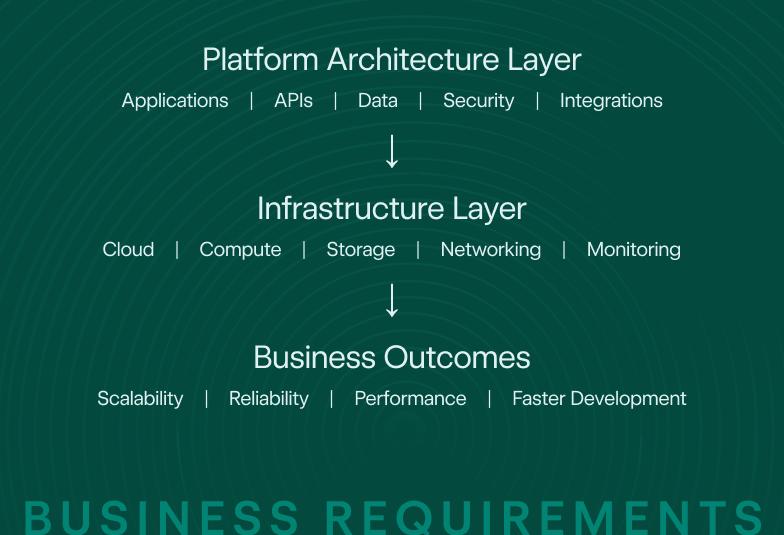
Enterprise Platform Architecture: What Changes at Scale?
As a business grows, its architecture has to support more than higher traffic. It may need to accommodate multiple products, development teams, data sources, integrations, regions, and security requirements.
This is where enterprise platform architecture becomes important. The focus shifts from making one application work well to creating a technical foundation that allows many systems and teams to work together reliably.
Handling Multiple Applications and Teams
Large organizations often have several applications serving different business functions. Without common architectural standards, each team may use different technologies, patterns, and integration methods.
Enterprise platform architecture consulting helps establish common principles while still allowing individual teams enough flexibility to move quickly.
Governance and Standardization
Enterprise platforms need clear standards around areas such as authentication, security, networking, logging, monitoring, and deployment.
AWS's platform architecture guidance specifically recommends establishing enterprise standards, blueprints, and guardrails to support consistent cloud adoption.
Security and Access Control
Security needs to be part of architecture from the beginning rather than added after implementation.
A scalable platform should define how users, applications, services, and APIs authenticate and communicate, while ensuring sensitive data and critical systems have appropriate access controls.
Observability and Reliability
As systems become more distributed, understanding what's happening across the platform becomes increasingly important.
Monitoring, logging, tracing, alerting, and automated recovery can help teams identify problems before they become major incidents. Google Cloud's Well-Architected guidance recommends observability, redundancy, and recovery planning as important parts of reliable architecture.
Cloud and Hybrid Architecture
Not every organization can move everything to the cloud. Some workloads may need to remain on-premises because of latency, data residency, compliance, or existing infrastructure.
A good architecture strategy considers these requirements instead of assuming that one deployment model works for everyone. AWS also highlights hybrid scenarios such as disaster recovery, distributed processing, and edge computing within its platform architecture guidance.
When Should You Consider Software Architecture Consulting?
You don't necessarily need an architecture consultant from day one. But there are certain situations where bringing in an expert can prevent expensive technical decisions later.
Before Building a New Platform
If you're starting a large product or platform, architecture decisions made early can have a significant impact on future development.
A consultant can help evaluate requirements, identify risks, select appropriate patterns, and create a technical roadmap before development gets too far ahead.
When Your Product Starts Scaling
If performance issues, deployment problems, or infrastructure costs start increasing as users grow, your existing architecture may need to evolve.
Software architecture consulting services can identify bottlenecks and determine whether specific components need to be redesigned, separated, or scaled independently.
When Technical Debt Slows Development
If adding a small feature requires changes across multiple parts of the system, your architecture may have become too tightly coupled.
An architecture assessment can help identify the root causes and prioritize improvements without requiring a complete rewrite.
During Legacy Modernization
Older applications often contain valuable business logic but rely on outdated technologies or architectural patterns.
Rather than replacing everything at once, consultants can create a phased modernization strategy that reduces risk while gradually improving the platform.
Before a Major Product or Cloud Migration
Moving to a new cloud environment or introducing a major technology platform can expose hidden dependencies.
An architecture review before migration can identify these dependencies and help teams plan the transition more effectively.
Platform Architecture Consulting vs. Software Development
The two disciplines work together, but they solve different problems.
| Platform Architecture Consulting | Software Development |
|---|---|
| Defines the overall system structure | Builds individual features and applications |
| Focuses on long-term scalability | Focuses on implementation and delivery |
| Establishes technology patterns | Applies those patterns in code |
| Defines integration and API strategy | Develops APIs and integrations |
| Identifies architectural risks | Resolves implementation-level issues |
| Creates technical roadmaps | Executes the roadmap |
In simple terms, architecture determines how the pieces should fit together, while development focuses on building those pieces.
Benefits of Working With Platform Architecture Experts
The right architecture can influence development speed, operational costs, reliability, and the ability to introduce new products.
Lower Long-Term Technology Costs
A well-planned architecture can reduce unnecessary infrastructure, duplicated systems, and expensive rework.
This doesn't mean choosing the cheapest technology. It means making technology decisions based on actual requirements and expected business value.
Faster Product Development
Clear interfaces and modular components allow development teams to work more independently.
Google Cloud recommends modular design because clearly separated components can be scaled and updated independently, allowing organizations to allocate resources where they're actually needed.
Better System Reliability
Reliable architecture reduces dependence on individual components and prepares the system for failures.
For critical workloads, redundancy and fault-tolerant design can prevent a single component or infrastructure failure from bringing down the entire system.
Easier Integration
A consistent API and integration strategy makes it easier to connect new products, partners, and services without repeatedly creating custom connections.
Architecture That Can Evolve
Perhaps the biggest benefit is flexibility.
A good architecture doesn't try to predict every future requirement. Instead, it creates enough flexibility for the business to adapt as its products, customers, and technology needs change.
How to Choose the Right Architecture Consulting Partner
The architecture partner you choose will influence some of your most important technical decisions. Look beyond a company's list of technologies and evaluate how they approach architecture problems.
Experience With Enterprise Platforms
Look for experience designing systems that support multiple applications, teams, integrations, and environments.
Strong Technical and Business Understanding
The right consultant should understand both sides of the problem.
They should be able to translate business requirements into technical decisions instead of recommending technology without understanding why you need it.
Experience With Modern Cloud Architectures
Cloud architecture requires careful consideration of scalability, security, reliability, performance, and cost.
Google's current Well-Architected Framework organizes these concerns into dedicated pillars and applies them across cloud, hybrid, and other deployment scenarios.
API and Integration Expertise
If your platform needs to connect with multiple internal or external systems, look for a partner with strong API architecture and integration experience.
Ability to Work With Existing Systems
Your business may not have the option of starting from scratch. A good architecture partner should be comfortable assessing existing systems and improving them incrementally.
Focus on Practical Solutions
Avoid partners that automatically recommend complex architectures because they sound modern.
The best solution is usually the one that meets your requirements while keeping operational complexity under control. Google Cloud's architecture guidance similarly recommends starting simple and avoiding unnecessary over-engineering.
Why Choose Notionmind for Platform Architecture Consulting?
Notionmind helps businesses design and modernize software platforms with architecture decisions aligned to their products, teams, and long-term goals.
Our platform architecture consulting approach focuses on creating systems that can scale without adding unnecessary complexity.
Business-Aligned Architecture Strategy
We start by understanding what the business needs to achieve, then translate those requirements into practical architecture decisions.
Scalable Enterprise Platform Architecture
From application structure and cloud infrastructure to APIs and data flows, we help businesses create architectures designed to support future growth.
API and Integration Architecture
We help design integration strategies that make it easier to connect applications, third-party services, and internal systems as the platform expands.
Modernization and Migration Support
If an existing system is limiting growth, we can assess the architecture and identify practical ways to modernize it without disrupting the business.
Architecture Built for Long-Term Growth
The goal isn't simply to fix today's technical problems. It's to create an architecture that gives your team room to build, change, and scale.
Explore Notionmind's Enterprise Architecture Services.
Conclusion: Build for Growth, Not Just for Today
Scaling software successfully starts with making the right architecture decisions before complexity gets out of control. Platform architecture consulting helps businesses evaluate existing systems, identify technical risks, and design a foundation that can support growth.
The right architecture doesn't have to be complicated. It needs to be scalable, reliable, secure, and flexible enough to evolve with the business.
Whether you're launching a new platform, modernizing a legacy system, or preparing for enterprise-scale growth, the right architecture strategy can make the difference between constantly fixing problems and having a platform that is ready for what's next.